Agents for science · Preprint, 2025
FMIRAgent
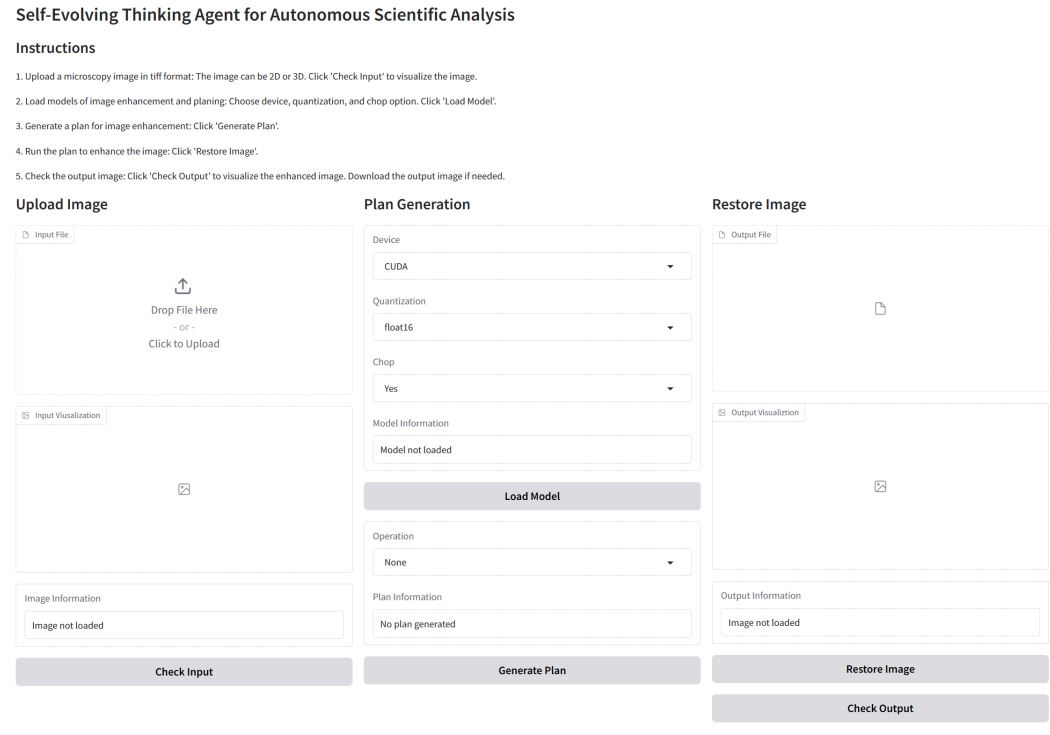
FMIRAgent connects visual perception, reasoning, and restoration strategies for microscopy.
Explore the code
Ruian He 何瑞安
Researcher & engineerI am an Algorithm Engineer at Alibaba Cloud and a Postdoctoral Researcher at Shanghai Jiao Tong University. I am currently advised by Prof. Linfeng Zhang and Dr. Xiantao Zhang.
I received my Ph.D. in Computer Science from Fudan University in June 2026, advised by Prof. Bo Yan, and my bachelor's degree in Computer Science from Fudan in 2021.
My research interests span computer vision, multimodal language models, and agentic AI.
Alibaba CloudAlgorithm Engineer · Since October
Shanghai Jiao Tong UniversityPostdoctoral Researcher · Since October
Alibaba CloudIntern
Microsoft Research AsiaResearch Intern · Shanghai System and Engineering Group
Chain-of-thought reasoning for multimodal language models
Fudan UniversityPh.D. in Computer Science · September 2021 – June 2026
Fudan UniversityBachelor's degree in Computer Science
Agents for science · Preprint, 2025
FMIRAgent connects visual perception, reasoning, and restoration strategies for microscopy.
Explore the code
Scientific imaging · Nature Methods, 2024
UniFMIR uses pretraining to address a range of fluorescence microscopy image restoration tasks.
Read the paper
Efficient visual computing · AAAI, 2024
Space-time supersampling brings frame extrapolation and supersampling into one low-latency framework.
Read the paper23 papers · * Equal contribution.
Structured knowledge and visual retrieval to support multimodal reasoning in microscopy.
Difficulty-aware selection allocates data budgets across classes for efficient model fine-tuning.
We propose Trajectory Space-Time Super-Resolution (T-STSR), a method designed to boost frame rates and resolution in fast subcellular imaging while significantly reducing computational overhead.
We show that pretraining on approximately one million synthetic images allows a retinal foundation model trained on only 16.7% of 904,170 real images to match or exceed the performance of RETFound trained on the full dataset across nine tasks.
We introduce MDSR-Zero, a zero-shot online learning method designed for plug-and-play noise suppression and super-resolution of microscopy videos.
A diverse facial optical-flow dataset and a decomposed model for facial motion estimation.
We provide a universal fluorescence microscopy-based image restoration (UniFMIR) model to address different restoration problems, and show that UniFMIR offers higher image restoration precision, better generalization and increased versatility.
A unified approach to frame supersampling and extrapolation for low-latency real-time rendering.
Through theoretical analysis, we find the pre-trained large vision models are helpful in optical flow estimation, and SAM is suitable for solving the fragmentation problem.
A learned iteration policy adapts the computation budget to each optical-flow sample.
We develop an Uncertainty-Guided Spatial Pruning (UGSP) architecture to skip redundant computation for efficient frame interpolation dynamically.
We propose an optical flow model, MVFlow, which uses motion vectors to improve the speed and accuracy of optical flow estimation for compressed videos.
Multi-frame differences and multi-scale features improve infrared UAV detection.
We propose a novel fine-grained blind face inpainting framework and build up a new dataset called CelebO-3D.
We propose a task-specific framework which first combines occlusion discarding and feature completion together to reduce the interference of occlusions on instance level.
No published papers match your search.
Long-horizon browser agents designed for tasks in real-world web environments.
A microscopy visual-question-answering corpus with graph-based quality control and human screening.
An agent that reasons about image degradation, selects restoration strategies, and explains its decisions.
Vision-language knowledge guides Segment Anything toward cross-domain microscopy segmentation.
Behavior-aware particle matching improves interpolation for fast live-cell imaging.
A 3D-aware generative framework disentangles facial identity and expression without paired supervision.
Text instructions edit audio-driven neural talking faces while preserving lip synchronization.
Hierarchical representations connect valence-arousal estimation, expression recognition, and action-unit detection.
No preprints match your search.